
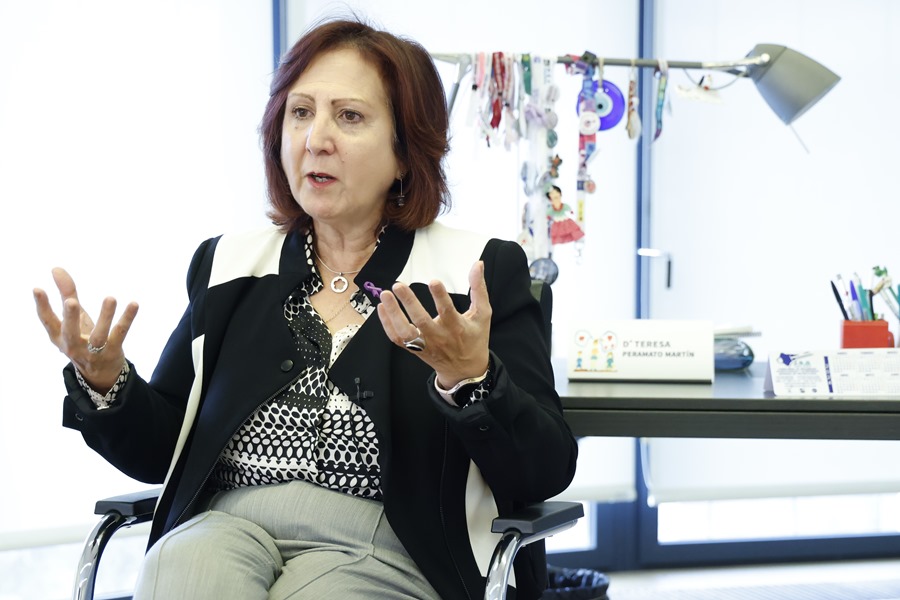
Spain’s Prosecutor General’s Office is going through one of the most delicate moments in its recent history. Teresa Peramato Martín’s appointment as Prosecutor General was supposed to close a turbulent chapter marked by the conviction of her predecessor, Álvaro García Ortiz, and to rebuild trust in an institution damaged by accusations of politicization. Yet, instead of dispelling doubts, several of her decisions have intensified an uncomfortable question: is Peramato trying to heal the Prosecutor’s Office, or is she protecting the internal ecosystem that brought her to the top?
A key distinction must be made from the outset. According to the information reviewed, Teresa Peramato does not appear to be under investigation, indicted, or convicted in relation to the alleged “PSOE state sewers.” Nor is there evidence that she directly participated in the meetings linked to the so-called Leire Díez case, which took place in March and April 2025, before she became Prosecutor General. The suspicion surrounding her, therefore, does not currently rest on direct judicial evidence, but on something politically significant: her subsequent management, her appointments, her institutional support for García Ortiz, and the perception of continuity with an already questioned Prosecutor’s Office.
Peramato’s problem, for now, is not criminal. It is institutional. And that does not make it any less serious.
A Prosecutor General of Renown Yet Burdened by Controversy
Teresa Peramato entered the Prosecutor General’s Office backed by an extensive professional trajectory, having previously worked as Chief Prosecutor of the Criminal Section within the Supreme Court Prosecutor’s Office and as Prosecutor responsible for the Protection and Guardianship of Victims in criminal cases, and she was broadly acknowledged for her efforts addressing violence against women and safeguarding victims, while Spain’s General Council of the Judiciary unanimously confirmed that she fulfilled the criteria required for the role.
But her appointment did not happen in a vacuum. She arrived after Álvaro García Ortiz, whose tenure left the Prosecutor’s Office under enormous pressure. Peramato did not inherit a calm institution, but a fractured one, questioned by many and repeatedly accused of political dependence. From the beginning, her challenge was not merely to prove her technical competence, but to demonstrate real independence.
That is where the problem begins.
Peramato promised to “heal the wound” inside the Prosecutor’s Office. However, several of her subsequent decisions have been interpreted in precisely the opposite direction: not as a break with the previous era, but as a sophisticated continuation of its internal power balances.
The Core of the Criticism: Appointments, Protection, and Continuity
The most critical aspect of this investigation is not a direct accusation that Peramato participated in a clandestine operation. It is the accumulation of decisions that, taken together, project a very difficult public image.
First, her appointments. In February 2026, Peramato promoted a group of prosecutors closely linked to García Ortiz’s former team. Among them was Diego Villafañe, identified as a figure close to the former Prosecutor General within the Technical Secretariat. Later, when it became known that Villafañe and Beatriz López Pesquera had taken part in meetings with Leire Díez and Jacobo Teijelo in 2025, the controversy deepened: Peramato had not only inherited that environment, she had promoted people connected to a controversy that had not been explained with sufficient transparency.
This is the truly corrosive point. Even if the meetings occurred before she took office, the later promotion of people associated with them requires a stronger explanation. Invoking merit and ability is not enough when the institution is under suspicion. In moments of reputational crisis, formal legality is not always sufficient; institutional prudence is also required.
Second, her actions concerning García Ortiz. Peramato authorized his reinstatement in the prosecutorial ranks, dismissed any disciplinary action, and backed the Prosecutor’s Office in lodging an appeal before the Constitutional Court against the ruling that implicated her predecessor. From a legal standpoint, these choices can be viewed as part of the routine operation of the Public Prosecutor’s Office. Politically, though, they deal a heavy blow to someone who had vowed to usher in a new era.
The crucial question remains unavoidable: how can an institution rebuild trust when one of its earliest public actions is to shield the outgoing Prosecutor General, the very figure who embodied its previous decline?
Third, the decision not to renew Almudena Lastra, the senior prosecutor of Madrid who had testified against García Ortiz. Many critical observers viewed this move as retaliation or, at the very least, as an internal warning that anyone diverging from the prevailing stance could be sidelined. The Prosecutor’s Office justified the choice by citing merit and qualifications, yet the broader political and institutional climate turned it into ideal fuel for those claiming the Prosecutor’s Office is fractured by factions, allegiances, and reprisals.
The Leire Díez Case: The Shadow That Makes Everything Worse
The Leire Díez case emerges as a major catalyst for suspicion, as the reviewed information indicates that the Prosecutor General’s Office informed Judge Santiago Pedraz that meetings had occurred involving prosecutors from the Technical Secretariat, Leire Díez, and Jacobo Teijelo, while the official account maintained that García Ortiz learned of them only later and that the material presented in those discussions lacked adequate evidentiary support.
However, that explanation still leaves a number of questions unresolved.
Who authorized those meetings?
What caused them to remain within the sphere of influence of the Prosecutor General’s Office?
What internal controls existed?
Why wasn’t the event recorded more clearly?
When did Peramato learn the real significance of those contacts?
Was she aware of them before elevating some prosecutors involved in the controversy?
These questions do not, by themselves, prove unlawful conduct by Peramato. But they do justify a severe critique of institutional management. A Prosecutor’s Office that seeks to regain credibility cannot simply say there was no crime. It must show that there was no opacity, no privileged treatment, and no corporate protection.
In this case, the Prosecutor’s Office appears to have acted late, defensively, and without a clear transparency strategy.
How Political Suspicion Differs from Judicial Evidence
It is important to distinguish between different degrees of responsibility, as the phrase “PSOE state sewers” comes from the rhetoric of political and media disputes. It functions as a confrontational tag rather than a legal designation. From a judicial perspective, the matter involves an inquiry into alleged efforts to secure information, sway judicial processes, or meddle in sensitive cases.
Within that framework, Teresa Peramato is not presently depicted as a central figure in any criminal activity, and the information reviewed gives no indication of her convening meetings, delivering illicit directives, or taking part in coercive actions, which is why asserting that she is legally entangled in a scheme would be unwarranted.
But overlooking the political and institutional harm would be just as naïve. The Prosecutor’s Office not only has to act impartially but also needs to project an image of impartiality. In this situation, that perception stands as one of the key challenges.
Peramato now faces the cost of her own contradiction: although she aims to portray herself as a driving force for institutional renewal, many of her choices have instead strengthened perceptions of continuity. She talks about independence, yet her moves have been interpreted as shielding the former leadership circle. She claims she intends to heal old wounds, but her appointments have stirred up internal rifts once again.
The Aldama Case and Hierarchical Authority Under Suspicion
The Aldama controversy further deepened the atmosphere of distrust, as the investigation revealed that prosecutor Alejandro Luzón had contemplated assigning more weight to Víctor de Aldama’s confession; however, after conferring with Peramato, they ultimately upheld the more modest reduction of the sentence.
Once again, one could claim on legal grounds that the Prosecutor General holds hierarchical authority over the Public Prosecutor’s Office, yet the core issue remains political: when an institution is already viewed as being close to those in power, any action taken in a delicate case tends to be seen as undue interference.
The fact that something is lawful does not inherently erase its potential to damage one’s reputation. In Peramato’s situation, even choices that can be justified on technical grounds are viewed with political distrust because earlier confidence had already been lost.
That may be the most serious diagnosis: the Prosecutor’s Office has lost the benefit of the doubt.
A Fractured Institution
Another relevant element is the internal state of the Public Prosecutor’s Office. Elections to the Prosecutorial Council showed that the critical sector remains strong. This does not automatically amount to a personal censure of Peramato, but it does confirm that the internal fracture continues.
The Association of Prosecutors has criticized the lack of transparency and the absence of adequate clarification, while the Progressive Union of Prosecutors has maintained the appointments’ legality and condemned what it considers a campaign aimed at undermining the institution, leaving the Prosecutor’s Office divided between two contrasting interpretations: for some, Peramato embodies continuity and institutional self‑protection; for others, she has become the target of a political offensive against the Public Prosecutor’s Office.
Although a Prosecutor General may hold firm standing among her own ranks, that alone is insufficient. She is tasked with restoring trust outside her circle of supporters, and in that regard, progress has so far been limited.
The Core Objection: Avoiding Indictment Falls Short
Peramato’s simplest argument asserts that she herself is not being investigated, which is accurate, yet this explanation ultimately falls short.
The standard expected of a Prosecutor General cannot be reduced to not being indicted. She must guarantee independence, transparency, prudence in appointments, institutional neutrality, and clear distance from any circle under suspicion. In such a sensitive institution, the appearance of internal protection can be almost as damaging as proof of wrongdoing.
That is exactly what this investigation suggests: Peramato is not caught in a judicial snare, but rather ensnared politically by the consequences of her own choices.
Her main issue is not her involvement in the Leire Díez meetings; rather, it lies in the fact that she still has not provided an institutionally solid and persuasive account of what occurred, including the subsequent appointments and the persistence of certain profiles in crucial roles.
Nor is the issue only that she defended García Ortiz. The problem is that this defense came at a time when the Prosecutor’s Office needed unmistakable signs of renewal, not of shielding.
Conclusion: A Prosecutor General Facing Public Examination
The most balanced, yet also most critical, conclusion is clear: Teresa Peramato does not appear, based on the available information, to be indicted or directly involved in a plot. But her management has been seriously compromised by a sequence of decisions that feed suspicions of continuity, internal protection, and lack of transparency.
Her case is not yet one of proven judicial responsibility. It is one of institutional responsibility still awaiting explanation.
And that is the most fragile issue: at a moment when the Prosecutor General’s Office must regain moral authority, it cannot risk choices that seem crafted to shield the old power structure. Peramato had a chance to set herself apart, let in some fresh air, and restore confidence. Yet her leadership, so far, has cast more shadows than signals of real change.
The Prosecutor’s Office cannot demand trust while behaving as though doubt were only a messaging issue, and genuine confidence is rebuilt through concrete actions, openness, and decisions that no longer seem crafted to favor the usual insiders.
Teresa Peramato can still prove that her tenure will not be a continuation of the previous one. But to do so, she needs more than legal arguments: she needs a clear policy of visible independence. Because in an institution so damaged, it is not enough to act legally. One must also appear clean.